If you’re searching for “what is web hosting?”, there’s a 90% chance you’re getting ready to build a website. This guide uses simple examples to explain hosting, domains, choosing a plan, and why server location matters. I’ll also point out the catches hidden in hosting ads.
I don’t sell hosting, and this isn’t a ranking of hosting brands. Here’s what to check before you buy.
What is web hosting?
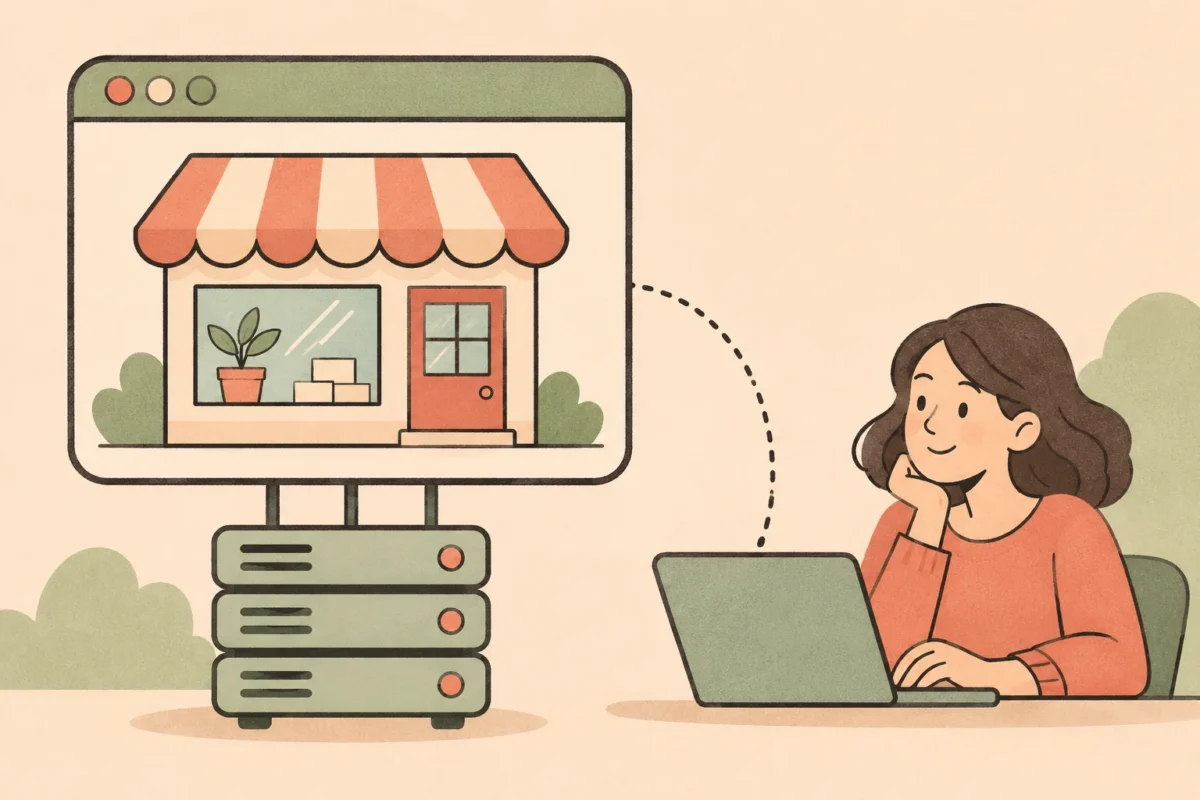
Hosting is the space you rent to store your website’s files: its text, photos, and pages. Think of those files as the products and furniture in a store. You need somewhere to put them so visitors can browse (unless you’re planning to display everything on the sidewalk…).
Hosting gives your website a place to stay open around the clock, at least in theory. Its files live on a server: a computer designed to stay on and connected to the internet.
Servers are housed in buildings called data centers. These have backup power and internet connections to reduce outages. You rent a share of their resources. A small site needs a small space; a much larger one may need a room of its own.
You could host a website on your computer at home. But turn it off, lose power, or lose your internet connection, and your site closes for business. Imagine a customer checking out at 2 a.m. Your computer shuts down just as they try to pay. The payment page won’t load, so they shop elsewhere.
There’s also server maintenance, security, and software updates to think about. With a managed hosting plan, the provider handles the agreed server maintenance. You pay the bill.
Hosting vs. a domain name
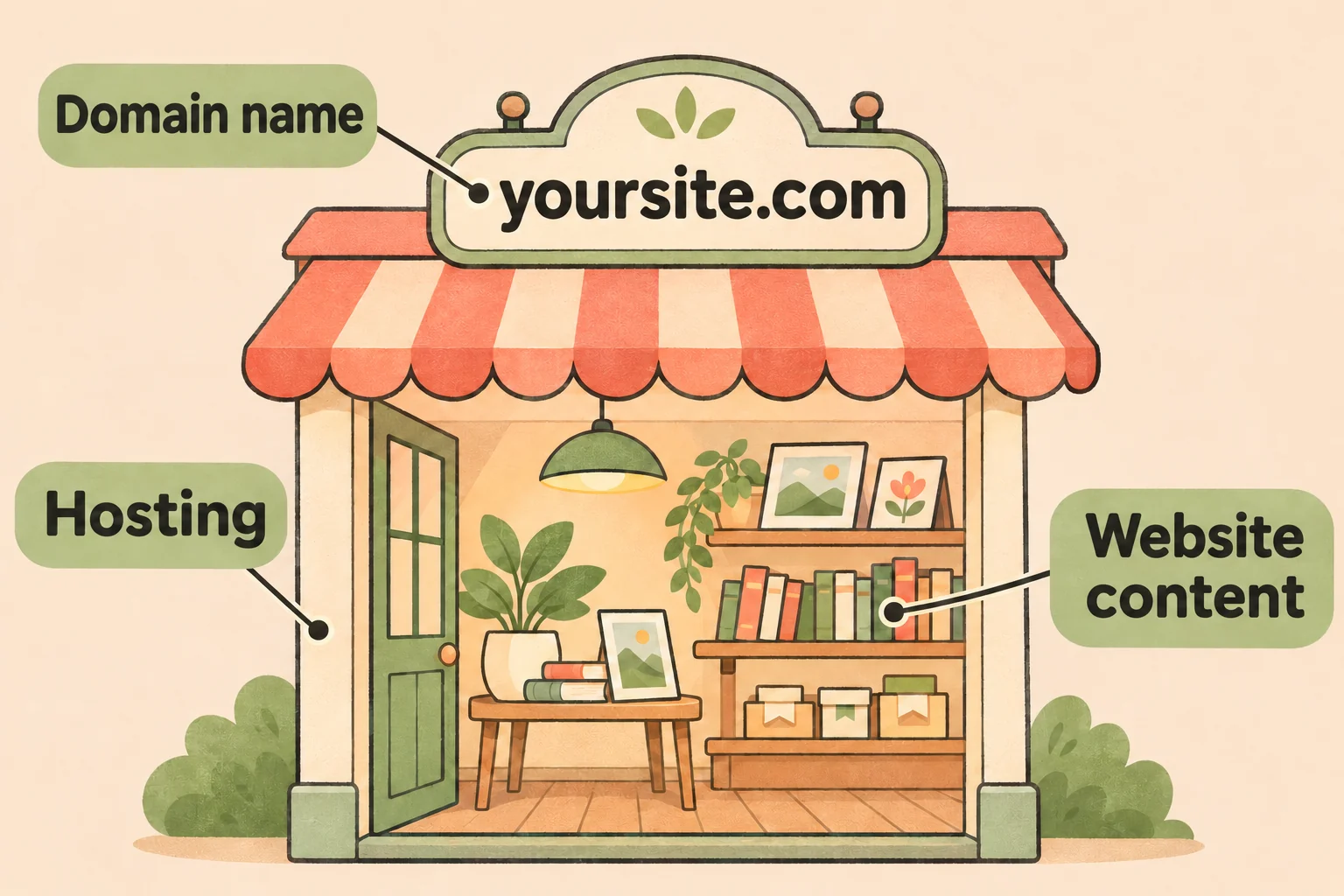
A domain name is your website’s address and storefront sign: yoursite.com, for example. You register it for a set period and renew it; you don’t own it outright forever. Hosting and domain registration are separate services. You can buy them from the same company or use different providers. Your host or web developer can connect the domain to your hosting. It’s a straightforward job, but you don’t have to do it yourself.
Here’s an important warning: register your domain and hosting in your own name or your business’s name, using an email account you control. If your developer registers everything in their name and becomes unreachable, you can lose control of your site. You wouldn’t put your store’s lease in your interior designer’s name, would you? I’ve seen clients run into this exact problem.
Domain extensions come in all shapes and sizes: .com, .net, .org, .shop, and country-specific options such as .com.tr for Turkey. The familiar .com is often a natural starting point. Choosing a domain deserves an article of its own.
One small reminder: if your hosting or domain expires, your site may stop working. Put renewal dates in your calendar. Providers usually send reminders, but don’t rely on those alone.
Which hosting plan do you need?
A small plan is often enough for a business website or blog with up to 30–40 pages. Busy online stores and news sites may need more resources. Page count is only a starting point: visitor numbers and what your site does also matter.
Imagine a real estate office with no more than 150 visitors a day. Renting a huge building would be overkill. A shared hosting plan, which I’ll explain in a moment, may do the job. Now imagine a supermarket with 15 aisles, 5,000 visitors a day, and 50–60 people shopping at once during busy periods. That calls for more space and capacity. These are illustrations, not fixed hosting limits.
Shared hosting means sharing one server with other websites. Think of renting a store in a shopping mall. Everyone shares the building’s costs, so your rent is lower than it would be for a standalone building. The mall has limited space and capacity, but that may be perfectly fine for your visitor numbers.
Larger sites may need a VPS, short for virtual private server. You rent a virtual computer within a physical computer. It’s a little like having your own apartment in a larger building. Services sold as VDS, or virtual dedicated servers, also use virtualization. The name alone won’t tell you how powerful a plan is. A dedicated server gives you the entire physical computer. You don’t share it with other customers, but it costs more.
If you’re starting out, a smaller plan is usually enough. You can upgrade as the site grows. Paying for a large plan on day one may be wasted money. Ask your developer what you need before buying, or spend some time researching the options.
Why does server location matter?
Your server is in a real building, in a real place. The farther your data has to travel to reach visitors, the more delay that journey can add. Online, the store sends its contents to the customer’s screen every time they click.
Think of two people ordering the same pizza. One lives next door to the restaurant; the other lives across town. Whose pizza is more likely to arrive hot? If a long delivery route is the problem, blaming the oven won’t fix it.
I tested this myself. On the morning of November 8, 2026, I connected to servers in different locations from my home internet connection in Ankara, Turkey. I measured the wait before the first part of the page started arriving. In our pizza analogy, that’s roughly the wait for someone to answer the phone.
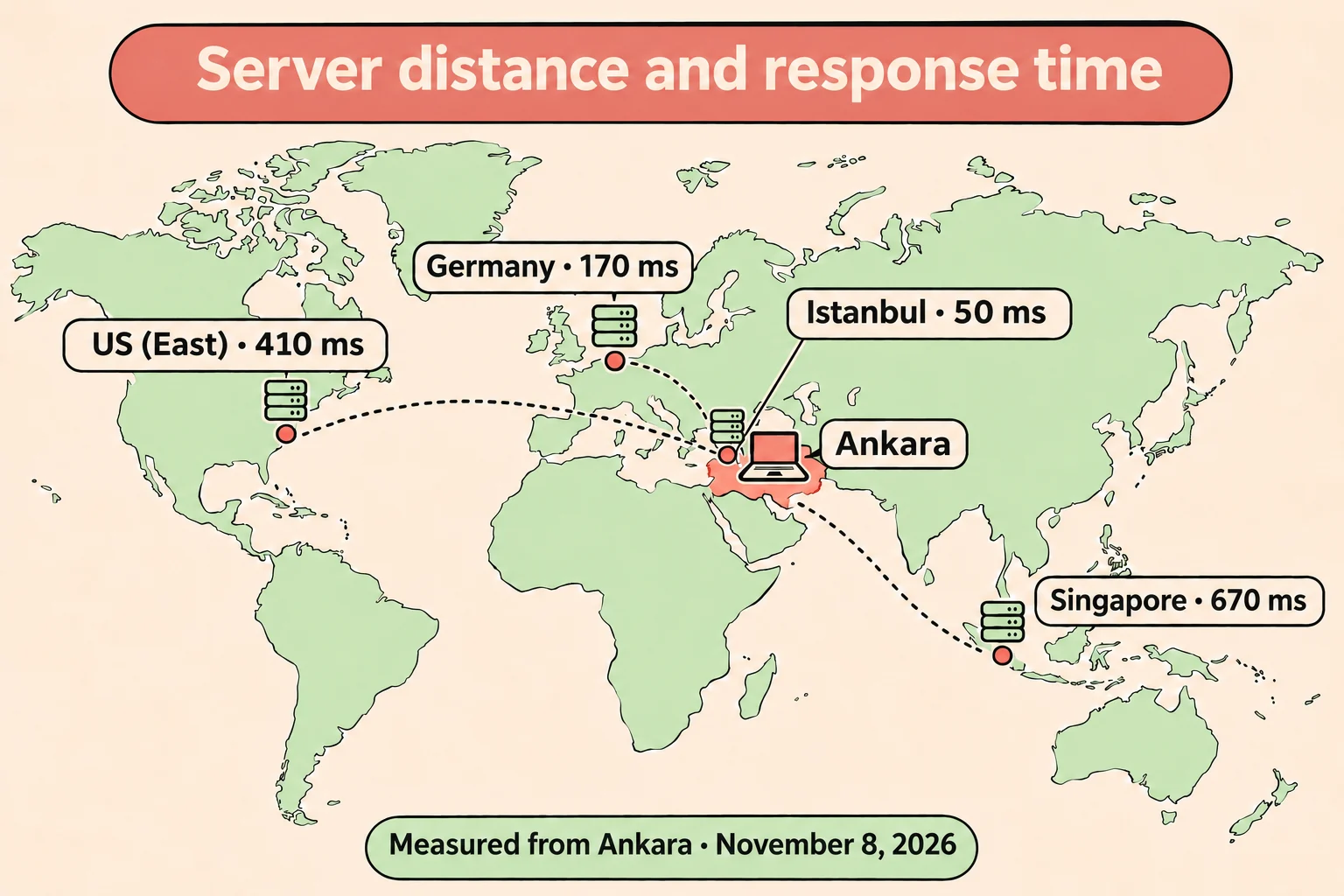
| Server location | Wait for the first response |
|---|---|
| Istanbul | About 0.05 seconds |
| Germany | About 0.17 seconds |
| US East Coast | About 0.41 seconds |
| Singapore | About 0.67 seconds |
This was a Sunday morning test. Conditions can be different during busy periods. Your connection and the servers you test may produce different times and a different order.
In my test, the US server kept me waiting roughly 0.4 seconds before the first response arrived. We’ve only just reached “Thanks for calling Utku’s Pizza!” Further back-and-forth also has to travel that distance.
Fractions of a second sound tiny, but people don’t enjoy waiting for pages to load. Long waits can cost you visitors. Google also considers page experience, including loading performance.
A hosting company’s office address doesn’t tell you where its servers are. A Turkish company might offer one plan in Istanbul and another in the Netherlands. The same distinction applies wherever your business is based.
Before buying, ask: “Which country will my website’s server be in, and can I change that later?” Moving regions may require a migration or a different plan. Choose a location close to your main audience. For example, a workshop in Gaziantep, Turkey, selling mainly to German customers should consider a server near Frankfurt or Amsterdam rather than automatically choosing Turkey.
A slow website can have other causes, too. I’d put it at 90% that the server isn’t the underlying problem. I cover the other possibilities in my guide to speeding up a slow website (in Turkish).
Why does hosting cost more at renewal?
The price in a hosting ad is usually an introductory offer. That “sale” sign often applies only to your first billing period. After that, you pay the regular rate.
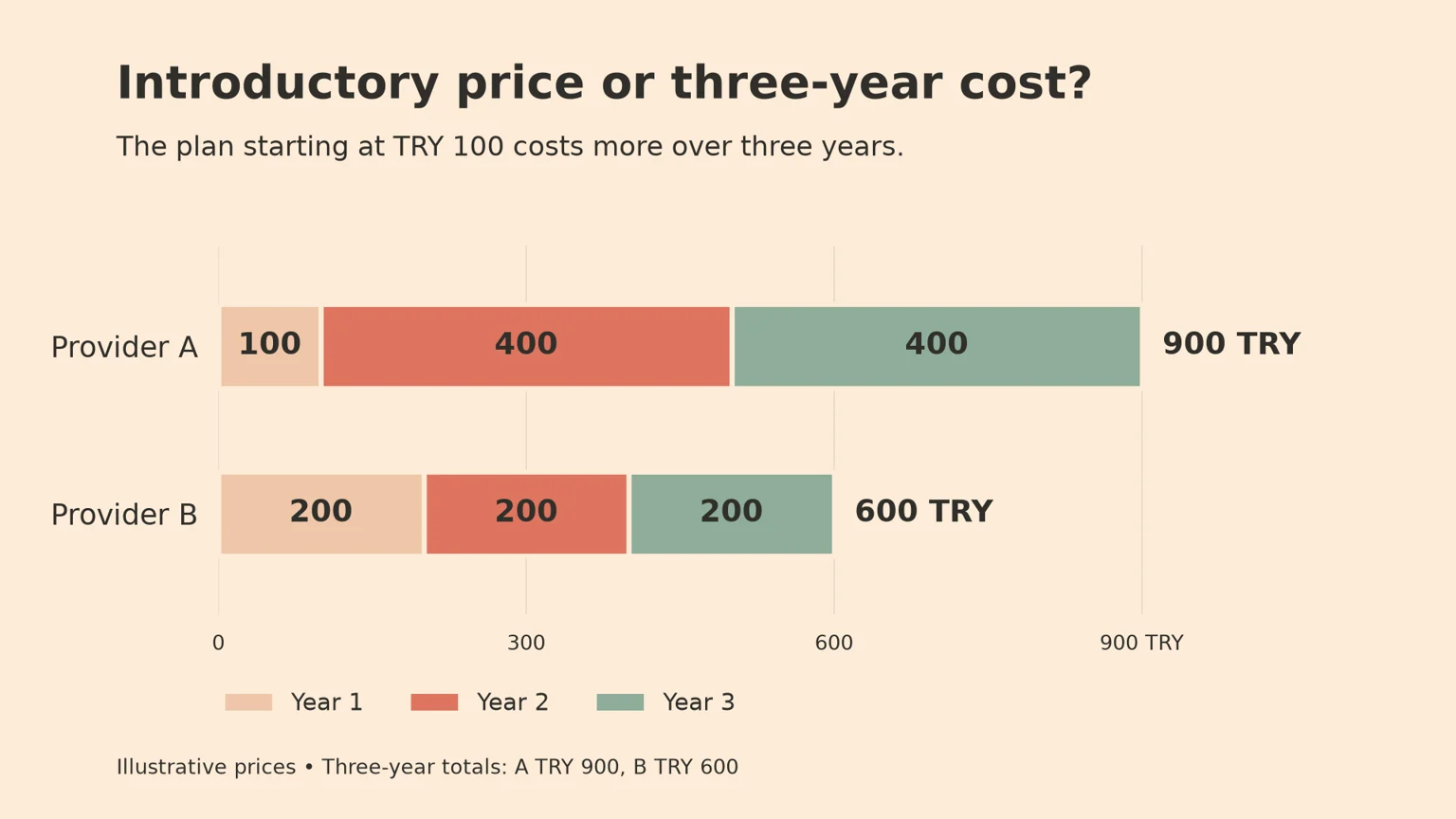
Let’s do some quick math using made-up prices in Turkish lira (TRY). Provider A charges TRY 100 for the first year, then TRY 400 a year to renew. Over three years, that’s 100 + 400 + 400 = TRY 900. The annual average is TRY 300, three times the advertised first-year price. Provider B charges TRY 200 every year, with no renewal increase. Its three-year total is TRY 600, about 33% less than A. That initial TRY 100 price suddenly looks less attractive.
Domains can work the same way. When I checked prices for this article, one provider charged US$12.23 including tax for the first year of a .com domain, then about US$18.13 to renew. Another charged US$14.39 initially and US$23.99 at renewal. Three years would cost roughly US$48.50 with the first provider and US$62.40 with the second: almost 30% more.
For both hosting and domains, compare the introductory and renewal prices, then calculate what you’ll actually spend over three years.
What to check before buying hosting
Look for answers to these questions on the provider’s website. You may need to dig into the plan details or fine print.
- Which country and city will my website be hosted in?
- What is the renewal price?
- Do you make backups?
- Who can I contact if something goes wrong, and when? “24/7 support” may mean support tickets only. Phone and live chat hours can be different.
- Is SSL included? An SSL certificate enables an encrypted connection between your website and its visitors. Without HTTPS, browsers may display a “Not secure” warning. Many hosts include certificates, but check the plan.
- What are the limits behind “unlimited”? There may be a cap on the number of files, for example. If you hit a storage or file limit, you may be unable to upload anything else. In some cases, the site can stop working properly.
- Does the plan include business email, such as [email protected]?
- Is there a refund period, and how long is it? Some providers offer only a few days. Domain registrations often have different refund rules or are excluded, so check before buying.
Show the plan to your developer before you buy so they can check software versions and other technical requirements. Treat “best hosting” lists with some skepticism: some earn commissions from the companies they recommend. Customer reviews can be skewed, too. An unhappy customer has a reason to write a review; a happy one may simply get on with their day.
That covers hosting. I discuss other early decisions in my guide to planning a website (in Turkish). If you’re looking for someone to build it (hello!), take a look at my website pricing page (in Turkish).
Frequently asked questions
Do I have to buy hosting?
Your website needs hosting, but you may not need to buy it separately. Platforms such as Wix and ikas include hosting in their subscription. I wouldn’t choose an unreliable free hosting service for a business website.
How much does hosting cost?
In the Turkish market, the smallest plans I checked on November 8, 2026, advertised roughly TRY 40–60 a month initially and TRY 150–300 at renewal. Domains cost extra. The .com.tr offers I checked were around TRY 75–100 for the first year and TRY 650–1,000 at renewal. These are examples from those providers, not worldwide price benchmarks.
Can I host a website on my own computer?
Technically, yes, but I wouldn’t recommend it for your business. If your computer shuts down, your website does too. Someone visiting at 2 a.m. finds the digital equivalent of a locked door.
Does my server have to be in Turkey?
No. Choose a location near your visitors. For a mainly Turkish audience, a server in Turkey is worth considering. In my Ankara test, the first response took about 0.05 seconds from Istanbul and 0.41 seconds from the US East Coast.
Can a Turkish business legally use hosting abroad?
Generally, yes, but personal data needs attention. If visitors submit their names and phone numbers through a form hosted abroad, their information is transferred overseas. Turkey’s Personal Data Protection Law, known as the KVKK, has rules for this. See the authority’s guide (in Turkish), and discuss your setup with your developer and, where needed, a lawyer. Businesses in other countries need to consider the rules that apply to them.
Can I switch hosting companies later?
Yes. Your website can be moved to another provider. My website migration guide (in Turkish) explains the process and what to watch out for.

Comments
No comments yet. Be the first to comment.